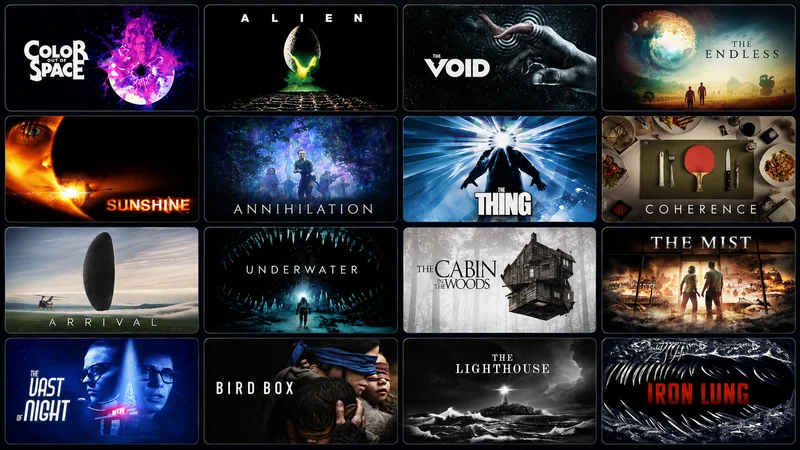
The best cosmic horror movies reveal a frightening possibility: humanity may be an insignificant accident in a universe governed by forces it cannot understand. The terror may come from an alien organism, a landscape rewriting biology, or a ritual that opens a door to something immense. This Top 35 brings together influential classics, Lovecraft adaptations, dimension-bending mysteries, and modern independent nightmares.
Readers discovering film recommendations through ReelShort can use this list to find stories with a genuine sense of cosmic scale, not merely any movie with an extraterrestrial creature. These features are works from different studios and filmmakers, not titles produced or distributed by the website. Some are slow and philosophical; others use practical effects, body horror, or dark comedy.
This guide to the best cosmic horror movies gives every pick a quick genre profile and two spoiler-light observations about why it belongs. We distinguish films that directly adapt H. P. Lovecraft from those that capture his central concern with the unknowable. Festival and wide-release years sometimes differ, and those distinctions are noted where important.
What Makes Cosmic Horror Different?
- Unknowable forces: A threat exceeds human understanding rather than behaving like a conventional villain.
- Cosmic indifference: Survival and morality may have little importance to the universe beyond Earth.
- Reality breaking down: Time, identity, biology, or physical space no longer follows familiar rules.
- Distinct styles: Expect eerie investigations, space survival, forbidden books, ritual cults, and grotesque transformations.
- Different scare levels: Some films are cerebral; others contain intense violence and disturbing body horror.
Cosmic horror is associated with Lovecraft, but a film can express its ideas without adapting his fiction or naming Cthulhu. The deciding question is whether the threat makes humans confront their limited place in a vast, indifferent reality. That is why these best cosmic horror movies include a few science-fiction and occult hybrids while excluding ordinary ghost films or monster attacks without that larger dimension.
Ancient Forces and Classic Cosmic Nightmares
The best cosmic horror movies often begin with a discovery that seems scientific, only to reveal a world much less predictable than anyone imagined. These nine classics use research stations, spaceships, ancient objects, and impossibly dangerous knowledge.
1. Quatermass and the Pit (1967)
- Subgenre: Archaeological science fiction horror
- Mood: Cerebral, ominous
- Best for: Classic British science fiction fans
Workers excavating a London Underground site uncover an object that seems older and stranger than recorded human history. Professor Quatermass investigates as discoveries point toward forces that could challenge humanity’s understanding of its own origins. The cramped excavation gradually expands into a troubling question about the species itself.
Its achievement is turning a scientific inquiry into existential unease. The film does not need tentacles at every turn because the suggestion of an inherited influence is disturbing enough. Choose it for intelligent, dialogue-driven horror where a discovery becomes more frightening as the investigators learn what it implies.
2. Alien (1979)
- Subgenre: Space survival and cosmic creature horror
- Mood: Cold, claustrophobic
- Best for: Space-horror beginners
A working crew aboard the commercial spaceship Nostromo investigates an unfamiliar signal and brings an organism into a vessel that offers no easy escape. Ridley Scott treats the ship as a believable industrial workplace. Against that ordinary machinery, the alien biology seems completely indifferent to human safety or explanation.
Although it is also a classic creature feature, Alien qualifies through its ancient, unexplained extraterrestrial setting and the sense that humanity has stumbled onto something it cannot negotiate with. Watch for the production design and the way an unseen corridor can feel like the edge of an uncharted universe.
3. The Thing (1982)
- Subgenre: Alien assimilation and isolation horror
- Mood: Paranoid, grotesque
- Best for: Practical-effects enthusiasts
Researchers in Antarctica encounter an organism capable of copying living creatures, leaving no dependable way to identify who remains human. John Carpenter transforms a remote station into a trap of suspicion. The alien can reshape itself in forms that ignore the usual boundaries of anatomy, making familiar colleagues frightening.
The practical transformations are extraordinary, but distrust is the film’s deepest horror. If even evidence from your own eyes might be unreliable, cooperation becomes dangerously difficult. This is an excellent starting point for viewers wanting both thrilling set pieces and the uniquely cosmic fear of an unknowable life-form.
4. From Beyond (1986)
- Subgenre: Lovecraft adaptation and body horror
- Mood: Psychedelic, disgusting
- Best for: Fans of outrageous creature effects
An experimental resonator stimulates perception and reveals organisms occupying a dimension that normally remains invisible. Stuart Gordon adapts Lovecraft’s story into a feverish collision of science, appetite, and bodily mutation. The machine changes not only what characters see but what can reach them.
Its most distinctive idea is that ordinary human senses may be protective limitations. Knowing more about the universe does not necessarily make anyone safer. Expect explicit body horror and a wild performance style rather than a restrained philosophical lecture; the excess is part of its appeal.
5. Prince of Darkness (1987)
- Subgenre: Occult science and apocalyptic horror
- Mood: Methodical, dread-soaked
- Best for: Fans of scientific supernatural mysteries
A priest and a group of researchers examine a mysterious cylinder beneath a Los Angeles church. Their investigation suggests a threat whose nature crosses religion, physics, and the boundaries of the known universe. John Carpenter makes repeated dreams and unsettling scientific observations part of the same worsening crisis.
The film turns abstract ideas about matter and evil into a concrete sense of something approaching. Its slower setup rewards viewers who like seeing scientists gradually run out of explanations. The cosmic quality lies in an ancient force that makes human religious and scientific categories feel incomplete.
6. In the Mouth of Madness (1994)
- Subgenre: Reality-warping literary horror
- Mood: Nightmarish, self-referential
- Best for: Viewers who enjoy mind-bending stories
An insurance investigator searches for a vanished horror novelist whose books seem to be changing the behavior of readers. The trip to an apparently fictional town makes the investigator question whether printed stories have begun replacing reality. John Carpenter lets the rules of the movie itself become unreliable.
Its combination of strange townspeople, impossible architecture, and anxiety about storytelling makes it an unusually direct cinematic expression of cosmic dread. Some listings use 1995 for its wider American release, but the film premiered in 1994. Watch it without seeking a tidy explanation of every event.
7. Event Horizon (1997)
- Subgenre: Deep-space dimensional horror
- Mood: Brutal, gothic
- Best for: Fans of haunted spaceships
A rescue crew boards a long-missing experimental spacecraft and discovers that its journey may have crossed into a reality no person was prepared to enter. Paul W. S. Anderson combines mechanical corridors with the imagery of religious nightmares. The ship seems less like abandoned equipment than a site contaminated by another dimension.
The film is stronger on atmosphere and disturbing concepts than on precise scientific explanation. Its hostile visions and violent imagery make it a demanding choice. For viewers seeking a haunted-house story without earthly walls, its suggestion that space exploration can open the wrong door is highly effective.
8. Uzumaki (2000)
- Subgenre: Japanese pattern-based cosmic curse
- Mood: Surreal, obsessive
- Best for: Fans of experimental Japanese horror
A Japanese town develops an inexplicable fixation on spirals, with ordinary shapes triggering increasingly abnormal behavior and bodily changes. Higuchinsky adapts Junji Ito’s manga into a world where an everyday pattern acts like an infection of perception. The town becomes vulnerable to a rule it cannot understand.
Uzumaki is less about a single monster than the terrifying possibility that reality contains hostile patterns. Its strange comedy and uneven adaptation choices will divide audiences, but the visual imagination is distinctive. This is the 2000 live-action film, not the later animated television adaptation.
9. The Mist (2007)
- Subgenre: Otherworldly creature siege
- Mood: Hopeless, confrontational
- Best for: Fans of survival horror with moral dilemmas
A dense mist settles over a Maine town, trapping shoppers inside a supermarket as unnatural creatures move outside. Frank Darabont adapts Stephen King’s story into a siege in which frightened people cannot agree on what the danger means. The creatures remain part of a larger, barely understood disturbance.
The cosmic terror comes from humanity’s sudden loss of importance in a world whose rules have changed. Yet the shoppers’ reactions are just as troubling as what is hidden beyond the glass. Choose it for frightening creatures and social pressure, and avoid detailed spoilers about its famously uncompromising finale.
Direct Lovecraft Adaptations and Cult Experiments
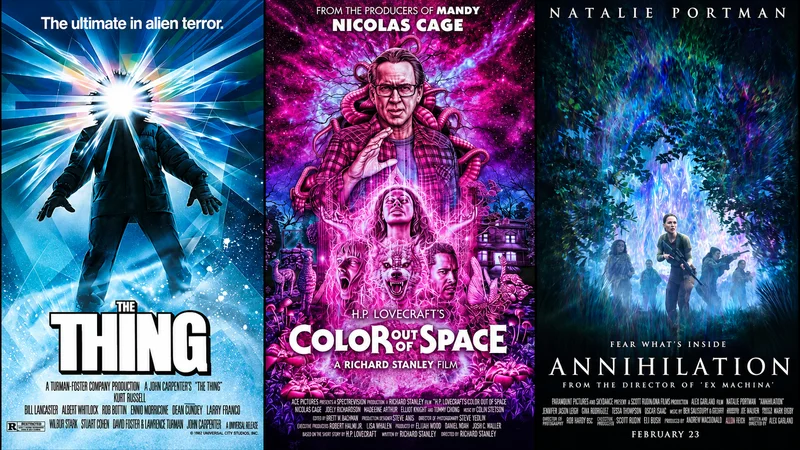
Not all of the best cosmic horror movies are faithful literary adaptations. This group compares early Gothic interpretations, outrageous cult effects, and deliberate recreations of Lovecraft’s original atmosphere, so viewers can choose between pulp spectacle and slow revelation.
10. The Haunted Palace (1963)
- Subgenre: Lovecraft-inspired gothic occult horror
- Mood: Elegant, sinister
- Best for: Fans of Vincent Price and vintage horror
A man inherits a New England mansion linked to a feared ancestor, only to find that the village remains haunted by the family’s reputation. Although marketed under an Edgar Allan Poe title, Roger Corman’s film draws on Lovecraft’s The Case of Charles Dexter Ward and the dangerous pull of inherited knowledge.
Its Gothic atmosphere makes it a useful early gateway to Lovecraft on film. The supernatural influence is more personal than the vast entities in later entries, yet the idea of ancient practices surviving through generations fits the larger tradition. Watch for the ornate imagery rather than modern pacing.
11. The Dunwich Horror (1970)
- Subgenre: Cult ritual and outer-god horror
- Mood: Occult, pulpy
- Best for: Viewers exploring vintage Lovecraft adaptations
A mysterious young man seeks a rare occult book connected to rituals in a New England community. The story adapts Lovecraft’s tale of a family reaching toward beings beyond normal human understanding. Its college settings and esoteric incantations make curiosity about forbidden knowledge central to the danger.
The production belongs to its era, including psychedelic effects and an exploitation-movie sensibility. It is not the most subtle cosmic film, but its direct use of Mythos ideas makes it historically valuable. Choose it for an early screen attempt to translate unknowable beings into commercial horror.
12. The Curse (1987)
- Subgenre: Meteorite contamination and rural body horror
- Mood: Grimy, tragic
- Best for: Fans of low-budget ecological horror
An unusual meteorite lands near a farming family, and its influence begins altering their water, crops, animals, and bodies. David Keith’s film relocates the terror of Lovecraft’s The Colour Out of Space into an American rural setting, with contamination reaching people through things they depend upon every day.
The cosmic threat is frightening precisely because it does not behave like a villain who can be confronted or reasoned with. The effects are messy and the storytelling rough, but the central image is strong: an alien presence changes the environment before anyone understands what arrived. Pick it for vintage creature and body horror.
13. The Resurrected (1991)
- Subgenre: Occult investigation and forbidden science
- Mood: Noir-like, grotesque
- Best for: Fans of detective-driven horror
A woman hires a private investigator to discover what her husband, Charles Dexter Ward, is doing in a remote ancestral property. Dan O’Bannon builds the mystery through strange chemical experiments and a family history that reaches into occult research. The inquiry gradually leaves conventional crime investigation behind.
This adaptation of The Case of Charles Dexter Ward is especially appealing if you prefer a trail of evidence before the monstrous revelations. Practical effects give its forbidden science tangible consequences. Some catalogs list its later United States release as 1992; the film is commonly dated to its 1991 premiere.
14. Necronomicon (1993)
- Subgenre: Lovecraft-inspired anthology
- Mood: Campy, grotesque
- Best for: Fans of creature-heavy cult collections
An imagined H. P. Lovecraft discovers a forbidden book that frames several unsettling stories. The anthology brings different approaches to obsession, unnatural life, and hidden worlds into one package, with Jeffrey Combs portraying the author in the connecting material. Each segment offers a separate doorway into strange fiction.
Because the tales have distinct creative teams, tone and execution vary. Its pleasure is discovering different interpretations of Lovecraftian motifs rather than following one sustained mystery. It is a particularly good pick for viewers who like practical effects and the unruly energy of 1990s anthology horror.
15. Dagon (2001)
- Subgenre: Coastal cult and maritime mutation horror
- Mood: Soggy, grotesque
- Best for: Fans of isolated villages and sea monsters
After a boating accident, travelers reach a Spanish coastal town where the residents behave strangely and the local religious practices conceal something alarming. Stuart Gordon draws heavily from Lovecraft’s The Shadow over Innsmouth despite naming the film Dagon. The streets and harbor become increasingly hostile as ordinary hospitality falls away.
Its fishlike transformations and decaying coastal atmosphere make the threat immediately physical, while the cult’s beliefs suggest much older powers beneath the town. It belongs to a wave of early-2000s genre experiments that favored tactile creatures and oppressive locations. Expect explicit transformations rather than refined psychological subtlety.
16. The Call of Cthulhu (2005)
- Subgenre: Silent-style Mythos adaptation
- Mood: Antique, investigative
- Best for: Lovecraft purists and silent-film enthusiasts
A scholar inherits research materials related to a strange cult and begins piecing together reports of a being whose influence stretches across countries and generations. The H. P. Lovecraft Historical Society presents the story in the style of a 1920s silent picture, complete with expressive sets and intertitles.
At roughly 47 minutes, it is shorter than most entries, but its deliberate retro craft makes it an essential exception. The filmmakers focus on how scattered testimony hints at something too large to comprehend. It is an ideal place to see Lovecraft’s original cosmic scale translated without modern franchise spectacle.
17. The Whisperer in Darkness (2011)
- Subgenre: Period alien conspiracy horror
- Mood: Mysterious, old-fashioned
- Best for: Fans of pulp-era investigative stories
Folklore scholar Albert Wilmarth investigates reports of unusual creatures in the Vermont hills and discovers evidence that may extend far beyond local legends. The H. P. Lovecraft Historical Society models the production on early sound-era adventure and monster films, giving the strange claims a convincing historical texture.
The pleasure is in the gradual expansion of a seemingly regional mystery into a terrifyingly larger cosmos. Retro effects and period storytelling are intentional choices rather than shortcomings. Choose it if you value investigation, conspiracy, and the unsettling suggestion that humanity is not the only intelligence in its environment.
18. Color Out of Space (2019)
- Subgenre: Alien environmental corruption horror
- Mood: Psychedelic, nightmarish
- Best for: Fans of vivid body horror
A meteorite lands on the Gardner family’s rural property, and an unnatural color begins distorting animals, plants, time, and behavior. Richard Stanley adapts Lovecraft’s story with saturated visuals and a performance by Nicolas Cage. Domestic routines become impossible when the surroundings stop obeying familiar physical rules.
The film embraces the terror of something that cannot be assigned a human motive. Its increasingly graphic transformations may overwhelm sensitive viewers, but its visual approach gives the unseen cosmic force an unusual presence. It premiered in 2019 and reached many theaters in 2020, which explains the differing dates in catalogs.
Mind-Bending Reality and Other Dimensions
In some of the best cosmic horror movies, the real antagonist is a rule that cannot be negotiated with. These nine films investigate hidden observers, altered time, ritual systems, and the terrifying possibility that the characters do not occupy the reality they thought they knew.
19. The Cabin in the Woods (2011)
- Subgenre: Meta-horror with cosmic mythology
- Mood: Playful, increasingly apocalyptic
- Best for: Genre-savvy viewers wanting surprises
Five friends visit an isolated cabin where conventional horror-film threats begin to emerge, but glimpses of a hidden operation suggest that their experience has been arranged. Drew Goddard builds an elaborate commentary on the rules of scary movies while slowly widening the stakes beyond an ordinary slasher premise.
Its cosmic connection is best appreciated without explaining the ultimate mechanism in advance. The movie is funny and energetic, yet its larger ideas ask why certain rituals and sacrifices recur in horror storytelling. Choose it for a group watch if you enjoy genre satire and can tolerate some graphic violence.
20. Resolution (2012)
- Subgenre: Unseen-observer psychological horror
- Mood: Conversational, unsettling
- Best for: Fans of small-budget mysteries
Michael travels to a remote cabin to help his friend Chris overcome an addiction, but the effort becomes entangled with unexplained recordings and increasingly odd encounters. Justin Benson and Aaron Moorhead begin with recognizable friendship tension before making the surrounding world feel like it is responding to the characters.
Its terrifying suggestion is that someone or something may be directing events according to rules the protagonists cannot see. It premiered in 2012 and received wider release in 2013. Watch it before The Endless if you enjoy discovering how two independent stories connect, though either film can be understood alone.
21. The Borderlands (Final Prayer) (2013)
- Subgenre: Church-set found-footage cosmic horror
- Mood: Creeping, sacrilegious
- Best for: Fans of ritual investigations
Investigators arrive at an old church in rural England to examine a reported miracle. Their equipment records phenomena that become more difficult to interpret, and the surrounding ground seems to contain a history beyond the religious explanations being offered. Elliot Goldner keeps much of the fear inside ordinary documentary procedures.
Its appeal is the movement from skepticism to a sense of overwhelming physical and spiritual scale. Readers curious about unseen entities and occult rituals can also explore our best paranormal horror movies collection, though this film pushes the mystery toward something less comfortably categorized. Released in the United States as Final Prayer, it premiered in 2013.
22. Banshee Chapter (2013)
- Subgenre: Conspiracy and dimensional-contact horror
- Mood: Paranoid, jumpy
- Best for: Fans of strange broadcasts and secret experiments
A journalist searches for a missing friend connected to a mysterious substance and disturbing recordings. The investigation moves between clandestine experiments, anomalous signals, and the possibility that human perception can open a path for entities from elsewhere. Its documentary-inspired style makes even fragments of information feel threatening.
The concept draws on the anxiety that attempts to enlarge consciousness may attract attention from something outside it. Some sharp scares sit beside a conspiracy-thriller structure, and the film works best for viewers who appreciate ideas more than polished spectacle. This is an especially uneasy choice for late-night headphone viewing.
23. The Void (2016)
- Subgenre: Cult and interdimensional body horror
- Mood: Bleak, slimy
- Best for: Fans of practical creature effects
A police officer brings an injured man to a hospital that soon becomes surrounded by mysterious robed figures. Strange changes inside the building suggest that the threat is not simply human violence. Directors Steven Kostanski and Jeremy Gillespie use unsettling practical monsters and a confined location to evoke forces outside ordinary reality.
The hospital setting gives the film a compelling siege structure, while the mythology remains intentionally larger than its characters. The dialogue is less memorable than the imagery, but the creatures make an impression. It premiered in 2016 and reached many audiences in 2017, so either date may appear on streaming listings.
24. The Endless (2017)
- Subgenre: Time-loop cult and existential horror
- Mood: Uncanny, melancholy
- Best for: Fans of high-concept slow burns
Two brothers return to a remote community they escaped years earlier after receiving a mysterious message. Familiar faces appear unchanged, while odd occurrences undermine the brothers’ incompatible memories of the group. Benson and Moorhead use the landscape and small mysteries to suggest the presence of an intelligence far beyond the residents.
The most effective fear is not one creature but a set of rules nobody can bargain with. It rewards close attention and provides an especially interesting companion to Resolution without requiring elaborate effects. Choose it for an emotionally grounded story about freedom, repetition, and the limits of human control.
25. Annihilation (2018)
- Subgenre: Ecological science-fiction cosmic horror
- Mood: Beautiful, disorienting
- Best for: Fans of cerebral visual horror
A biologist joins an expedition into the Shimmer, a region where an extraterrestrial event has altered the environment and biological rules. Alex Garland combines recognizable wildlife with impossible transformations. The deeper the expedition travels, the less useful the team’s scientific assumptions become, and even personal identity feels uncertain.
Its imagery is both gorgeous and genuinely disturbing, which captures a defining cosmic contradiction: discovery can be wondrous without being safe. The film is not a literal Lovecraft adaptation but embodies the fear of contact with a reality that does not care about human categories. It is among the strongest accessible modern choices.
26. The Lighthouse (2019)
- Subgenre: Maritime myth and psychological cosmic horror
- Mood: Hallucinatory, punishing
- Best for: Fans of ambiguous art-house horror
Two lighthouse keepers on a remote island descend into rivalry, superstition, and increasingly uncertain experiences. Robert Eggers uses black-and-white photography, harsh weather, and strange maritime imagery to make the work routine feel like an encounter with myth. Neither the men nor the audience can reliably separate perception from reality.
This is a border case for viewers expecting a clearly visible cosmic entity, but the overwhelming force of forbidden knowledge and the insignificance of its characters are central. Willem Dafoe and Robert Pattinson sustain the uneasy dynamic. Choose it for symbolic, abrasive horror rather than a neatly explained monster story.
27. The Empty Man (2020)
- Subgenre: Occult investigation and cosmic identity horror
- Mood: Brooding, expansive
- Best for: Fans of ambitious cult mysteries
An investigation into a missing young woman draws a former police officer toward a strange urban legend and an organization obsessed with a larger metaphysical idea. David Prior moves between detective fiction, ritual behavior, and the suggestion that identity itself may be less stable than it appears.
Its long running time and unusual structural shifts can divide viewers, but they also allow the threat to grow beyond a simple boogeyman. The film is better approached with little advance knowledge. Choose it for a cosmic mystery concerned with belief, thought, and the possibility of forces using people as instruments.
Modern Cosmic Horror from the Deep and Beyond
The best cosmic horror movies also work at smaller budgets and in unexpected spaces. The final eight titles find existential dread in the ocean, a holiday cottage, a bathroom stall, and a frozen research camp. Several use comedy or unusual formal experiments instead of traditional monster scares.
28. Underwater (2020)
- Subgenre: Deep-ocean science-fiction cosmic horror
- Mood: Fast, oppressive
- Best for: Fans of aquatic survival thrills
An engineering crew at a deep-sea drilling station struggles to escape after a catastrophic event damages the facility. Their route through the ocean floor reveals organisms and a scale of threat that make their machinery seem fragile. William Eubank combines physical pressure, darkness, and the uncertainty of what lies beyond the station lights.
It is more action-oriented than many cosmic stories, yet the enormous unknown beneath the sea makes it a natural choice for the subgenre. Its visual murk and rapid pacing will not suit everyone. Pick it when you want the sensation of confronting something ancient without a lengthy philosophical setup.
29. The Beach House (2019)
- Subgenre: Coastal infection and ecological cosmic horror
- Mood: Dreamy, sickening
- Best for: Fans of slow environmental dread
A young couple retreats to a shoreline home and notices increasingly unusual conditions affecting the water, the air, and nearby people. Jeffrey A. Brown begins with recognizable vacation discomfort before making the beach itself feel like evidence of an alien process. The change is not contained by any single hostile creature.
Its most unsettling idea is that the environment can become unrecognizable without anyone intending harm. The movie premiered in 2019 and received wider streaming distribution in 2020. Choose it for gradual atmosphere and unpleasant physical consequences rather than an elaborate mythology of named gods.
30. The Block Island Sound (2020)
- Subgenre: Maritime anomaly and unknowable intelligence
- Mood: Mournful, eerie
- Best for: Fans of quiet cosmic mysteries
Unusual events around a New England island begin affecting marine life and the behavior of a local fisherman. His family searches for explanations as the incidents grow more difficult to categorize. The McManus brothers use coastal isolation and an inexplicable signal to make the ordinary rhythms of a community feel disrupted.
The film is notable for its refusal to reduce the anomaly to a simple monster hunt. Human relationships remain central even when the scale of the mystery becomes frightening. It is a good choice for viewers who enjoy cosmic questions posed in an understated, family-centered style.
31. Glorious (2022)
- Subgenre: Rest-stop cosmic horror comedy
- Mood: Absurd, claustrophobic
- Best for: Fans of dark high-concept comedy
A devastated traveler stops at a roadside bathroom and discovers a voice speaking from the neighboring stall. The conversation suggests that the being on the other side possesses knowledge and needs far beyond anything the traveler can understand. Rebekah McKendry turns a cramped, unglamorous setting into an oddly vast metaphysical confrontation.
Ryan Kwanten brings panic and vulnerability, while J. K. Simmons supplies a memorable unseen presence. Its extreme tonal contrast will appeal to viewers willing to laugh at a story about cosmic stakes. The central joke never entirely cancels the frightening imbalance between a human listener and a purported god.
32. The Outwaters (2022)
- Subgenre: Experimental desert found-footage horror
- Mood: Disorienting, abrasive
- Best for: Viewers tolerant of abstract narratives
Four travelers enter the Mojave Desert to make a video project and encounter experiences that their recordings can barely communicate. Robbie Banfitch uses restricted visibility, distorted sounds, and broken spatial expectations to deny audiences the comfort of understanding exactly what is happening. The landscape becomes something stranger than a place to get lost.
This is among the most divisive choices because it values sensation over conventional explanation. Some viewers will find it terrifying; others may find its minimal visibility frustrating. It premiered in 2022 and reached wider theatrical audiences in 2023, a distinction worth knowing when searching for the film.
33. Suitable Flesh (2023)
- Subgenre: Lovecraftian body-swapping occult horror
- Mood: Lurid, playful, violent
- Best for: Fans of provocative cult horror
Psychiatrist Elizabeth Derby encounters a troubled young man whose account of his father suggests an impossible transfer of identity. Joe Lynch adapts Lovecraft’s The Thing on the Doorstep into an energetic story of possession, unstable bodies, and power used without consent. The cast includes Heather Graham and Barbara Crampton.
Its comic and erotic elements move it away from austere cosmic terror, but the fundamental threat involves a consciousness that treats human bodies as interchangeable vessels. Choose it for a modern companion to the unruly Stuart Gordon adaptations, and expect explicit content rather than a restrained ghost mystery.
34. Black Mountain Side (2014)
- Subgenre: Arctic archaeological cosmic horror
- Mood: Minimalist, paranoid
- Best for: Fans of remote-station mysteries
An archaeological team in northern Canada uncovers an ancient structure that should not fit its understanding of the region. As communication fails and strange behavior spreads, the isolation becomes as threatening as the discovery itself. Nick Szostakiwskyj uses the frozen landscape to suggest that the team has disturbed something older than its research methods.
It naturally invites comparisons with The Thing, though its resources and pace are much more modest. The main attraction is the suspicion that an archaeological find has implications far beyond a single excavation. Watch it for atmosphere and the fear of ancient knowledge, not large-scale effects.
35. The Last Winter (2006)
- Subgenre: Arctic ecological and supernatural horror
- Mood: Somber, politically anxious
- Best for: Fans of environmentally themed dread
Workers preparing an oil project in the Alaskan wilderness begin noticing disturbing changes in behavior and the landscape. Larry Fessenden mixes industrial ambition with the possibility that something ancient is responding to the intrusion. Cold, isolation, and competing priorities erode the group’s confidence in ordinary explanations.
The cosmic element is more interpretive than in a direct Lovecraft adaptation, but the film evokes humanity’s smallness before forces linked to the land. Some of its later effects can be divisive. It is worth including for viewers who want environmental anxiety and existential unease rather than a straightforward alien monster.
Which Cosmic Horror Movies Should You Watch First?
For a first encounter, Alien and The Thing deliver recognizable survival stories with a larger fear of extraterrestrial life. Annihilation is an ideal choice if you want striking images and philosophical questions without learning an elaborate fictional mythology first. The Mist adds a sharp study of human behavior when reality abruptly becomes hostile.
For patient investigators, start with The Endless, Resolution, or The Empty Man. Viewers drawn to the writer who shaped the subgenre can compare The Call of Cthulhu and The Whisperer in Darkness before trying the more grotesque From Beyond or Color Out of Space. Those films share literary roots but have very different rhythms and visual ambitions.
Some of the best cosmic horror movies are deliberately challenging. The Outwaters makes perception difficult, The Lighthouse thrives on ambiguity, and Event Horizon, From Beyond, and Suitable Flesh include intense disturbing material. If you prefer speculative unease to graphic imagery, Quatermass and the Pit or The Block Island Sound may be more rewarding. The best cosmic horror movies leave space for uncertainty rather than treating every mystery as a puzzle with a neat solution.
Frequently Asked Questions (FAQs)
What is cosmic horror in a movie?
Cosmic horror focuses on humanity confronting something vastly older, stranger, or more powerful than it can understand. The threat may be an alien intelligence, an impossible dimension, or a force that rewrites natural laws. Unlike many conventional monster stories, the fear comes partly from realizing that human plans and moral categories may not matter to whatever has been discovered.
Which cosmic horror movie is best for beginners?
Alien and The Thing are strong entry points because they use clear survival conflicts while presenting incomprehensible extraterrestrial life. Annihilation is a good choice for viewers seeking beautiful but disturbing science fiction. The Mist is more accessible as a siege story, although its violence and grim tone are not suitable for every audience. Start with the pacing you prefer.
Are cosmic horror and Lovecraftian horror the same thing?
They overlap, but they are not identical. Lovecraftian horror refers to stories influenced by or adapted from H. P. Lovecraft and his approach to forbidden knowledge and human insignificance. Cosmic horror is a broader narrative idea, so films such as Annihilation or The Block Island Sound can express cosmic dread without being adaptations of his work.
Do cosmic horror movies always show giant monsters?
No. A creature can make the universe feel threatening, but an unseen intelligence or a broken physical rule can create the same effect. The Endless uses strange patterns of time, while Resolution suggests an observer beyond the characters’ control. Other films use body transformation or hostile environments. Tentacles and ancient gods are familiar images, not requirements for the subgenre.
Final Thoughts
The best cosmic horror movies challenge the reassuring idea that human beings can understand every threat if they gather enough evidence. Whether a film shows a strange fossil, a distorted coastline, or a voice from another dimension, the lasting discomfort is the possibility that knowledge might reveal how little control anyone has. The strongest examples also give that idea emotional force through characters who still try to protect someone or make sense of their world.
Choose The Thing for paranoia, Annihilation for biological wonder and terror, or The Endless for a quietly devastating puzzle. If you want a direct conversation with Lovecraft, the Historical Society adaptations provide a distinctive route into his fiction. The most memorable entry is not necessarily the one with the largest monster, but the one that makes reality feel unfamiliar after the credits.